


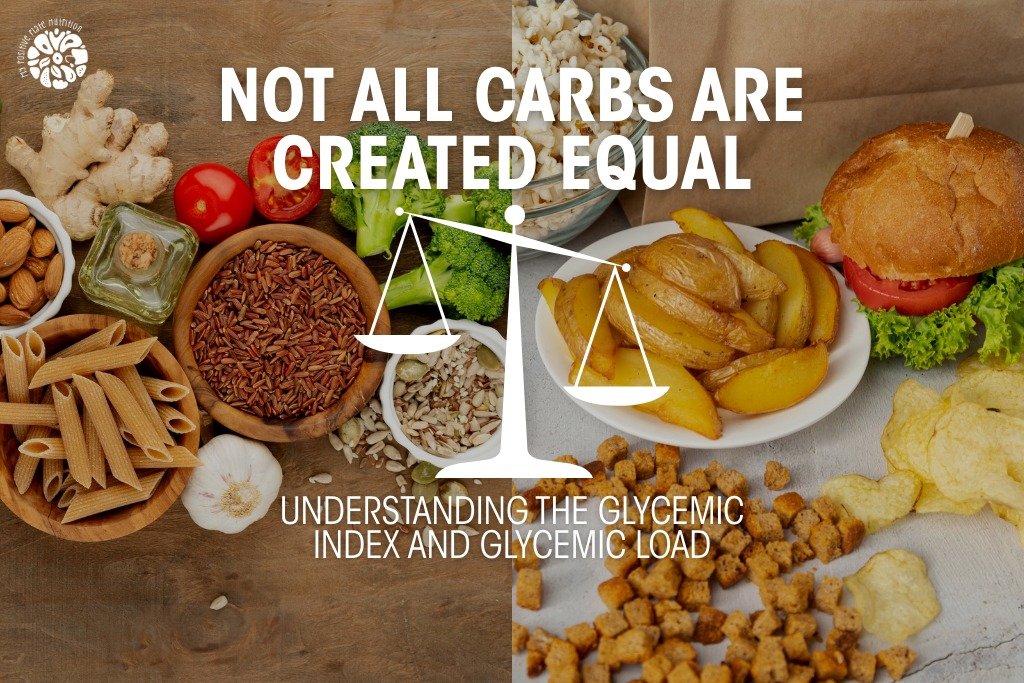
Learn the difference between the glycemic index (GI) and glycemic load (GL) and how they impact your blood sugar, energy, and long-term health—without cutting carbs.
Do you think all carbohydrates are the same? Would you say strawberries and bananas are the same just because they’re both fruits?
If that’s how we’re thinking, we might be missing the point.
Yes, both are fruits. Yes, both contain carbohydrates. But they don’t impact your blood glucose in the same way. For example, one cup of strawberries will not give your body the same blood sugar response as one cup of bananas.
I’m not saying bananas are bad. I’m simply pointing out that portion size and food type matter, even within the same food group.
This is where the philosophy of portion awareness becomes powerful.My approach centers on embracing whole foods because they naturally provide the right balance of nutrients, fiber, and satiety. Instead of focusing on cutting carbs, I encourage individuals to eat whole foods and be mindful of portions, especially in relation to how foods affect blood glucose.
This strategy removes the fear and rigidity often associated with dietary changes and replaces it with flexibility.
To support this approach, two helpful tools come into play:
The Glycemic Index (GI) and Glycemic Load (GL).
What’s the Glycemic Index?
The Glycemic Index measures how quickly a food raises your blood sugar. Foods are ranked on a scale of 0–100. High GI foods, like white bread, candy, or soda, give you a quick spike in energy but then leave you crashing. Low GI foods, like beans, lentils, and apples, provide steady energy without the rollercoaster effect.
Why does GI alone not tell the full story?
Here’s the catch: the GI score doesn’t consider portion size. For example, watermelon has a high GI, but you’d need to eat a lot of it for it to meaningfully impact your blood sugar. This is where Glycemic Load steps in.
What’s a Glycemic Load?
Glycemic Load looks at both the type of carb and how much you’re eating. It’s a more practical measure for real life. A food can have a high GI but a low GL if the serving size is small or the total carb content is modest. That’s why GL is often more useful when planning balanced meals.
Why Does This Matter to You?
Understanding both GI and GL can be a game-changer for your energy, cravings, and long-term health. While GI tells us how quickly a carbohydrate-containing food raises blood glucose, GL goes a step further, it considers how much carbohydrate is in a typical serving. This makes GL a more practical and powerful tool for everyday eating.
Paying attention to GL helps you maintain steady energy, reduce sugar crashes and cravings, and support metabolic health over time. It may even lower your risk of type 2 diabetes, heart disease, and other chronic conditions. The goal isn’t to ban carbs, It’s about knowing which carbs work best for your body, your health goals and how much of them to enjoy at one sitting.